 It is often asked as to why there is no one-to-one correspondence between spelling and pronunciation in English i.e., why don’t we pronounce the English words exactly according to their spellings? For example, if C-U-T is
  B-U-T is
  then why pronounce P-U-T as
  ? To understand this, we must first understand that in some languages in the world (as in Hindi or most Indian languages), one letter of alphabet stands for one sound in speech. Such languages are called ‘phonetic’ languages. English is not a ‘phonetic’ language. It means that in English one letter of the alphabet does not necessarily stand for one sound in speech. Every language has a particular number of sounds in it. The English language has 44 sounds. Among them, 20 are vowel sounds and 24 are consonant sounds. But the letters of the alphabet in English are only 26. Obviously, they cannot represent these 44 sounds. That is why, in English, we don’t pronounce English words exactly as per their spellings.
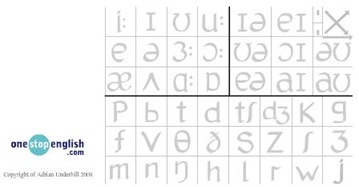
The next question then is- ‘how to represent the sounds in languages like English in written form (for dictionaries and linguistic documentation etc.)?’ The letters of the alphabet are lesser than the number of sounds. So they are unable to represent these sounds. What do we do then? To solve this problem, the linguists came up with a solution-a new script (or a new set of symbols) called the International Phonetic Alphabet (IPA) symbols. This script is language neutral. We can represent sounds in any language in this script. There are some languages in the world which are only spoken and never written. So they simply have no script at all. Many of these languages are on the verge of extinction. In order to preserve them, it was (and it still is) necessary to have a script that will be able to represent their sounds. The IPA symbols solved this problem. Now, have look at the adjacent chart with letters that look strange. Some of them seem to be like the letters of the English alphabet. This is a chart representing the 44 sounds of English language in IPA symbols. Please note that there are many IPA symbols but this chart consists of only those symbols that represent the sounds in English.
This is an interactive chart. Click on the picture of the chart to open it in a new browser window and then you can listen to the pronunciation of each sound followed by the pronunciation of an example word for that sound. Must have either Adobe Flash Player or the Shockwave plug-in installed on your computer for this interactive chart to work properly. If you don’t have them, you can download them by clicking their respective links below.

I am grateful to www.onestopenglish.com (from where I have taken this chart) and Adrian Underhill (who owns the copyright for this chart) for providing this wonderful learning resource. Have fun !
 Prithvirajsingh Thakur