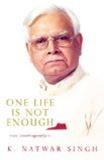
One Life is not Enough: An Autobiography
K. Natwar Singh. 464 pages. Rs. 500
Rupa Publications
978-81-291-3274-1
K. Natwar Singh is not a man you can ignore. You can love him, you can loathe him, but you certainly can’t ignore him. With an illustrious diplomatic career spanning three decades followed by twenty-five years in active politics, Natwar Singh has witnessed the history of modern India from close quarters. A self-proclaimed Nehruite, he has been an ardent supporter of the Nehru-Gandhi family, having worked with stalwarts like Jawaharlal Nehru, Indira Gandhi and Rajeev Gandhi. The autobiography of this octogenarian diplomat –turned –politician has created quite a stir and roused considerable interest with its startling revelations about Sonia Gandhi and her refusal to accept the prime minister’s post in 2004. However, the book cannot and should not be read only for these revelations and other spicy insider accounts that it contains. One cannot deny the fact that Natwar Singh, while telling his story, has also inevitably told the story of the making of modern India- particularly, its foreign policy. While doing so, he has given us interesting pen-portraits of the people who did it -the visionary and idealistic (but at times temperamental) Jawaharlal Nehru, the stern, majestic and capricious Indira Gandhi and the young dreamy romanticist- Rajeev Gandhi. We also have some delightful portraits of the world’s who’s who of past half-a-century.
Natwar Singh had a good fortune to work with all the top three Nehru-Gandhis- Jawaharlal, Indira and Rajeev.
Born to Govind Singh and Prayag Kaur, Natwar Singh’s childhood was spent in Bharatpur and Deeg. His father was a Diwan of the Bharatpur principality. Natwar was educated at Mayo College, Ajmer, Scindia School, Gwalior and St. Stephen’s College, New Delhi from where, he graduated in history with honours. Natwar Singh later went to Cambridge for further study and while at Cambridge, he entered into the Indian Foreign Service in 1953. After a long bachelorhood, he married Maharajkumari Heminder Kaur of Patiala in 1968.
After Nehru, he worked closely with Indira Gandhi with a long stint in her secretariat, followed by postings as Ambassador to Poland and later to Zambia (where he was posted by Morarji Desai as a punishment) and still later as High Commissioner to Pakistan. A trusted aid of Indira Gandhi, he successfully organized the CHOGM and NAM summits in New Delhi in 1983 after which he resigned from the Foreign Service to join politics. After the elections that followed the assassination of Smt. Indira Gandhi, he was elected to the Lok Sabha from Bharatpur constituency on a Congress ticket. He was made Minister of State for Steel under Rajiv Gandhi.
While it is true, that most of Natwar Singh’s life and diplomatic career can be reconstructed from his earlier books- Profiles and Letters, Walking with the Lions, My China Diary and Yours Sincerely (a collection of letters written to him by the high and mighty), we are still not short of new information and anecdotes in his book. There are quite a few revelations. For instance, he looks back at the Rajiv era with a mixture of reverence for the man and regret for his policies. We are told how Rajiv mishandled the Sri Lankan problem, the Shah Bano case and the Ram Janmabhoomi issue. However, there is praise for Rajiv Gandhi’s China policy and his futuristic vision, while most of his advisers are scoffed at. We are later told about teh woes of the Congress in the post-Rajiv years and how Sonia Gandhi played a decisive role in making P.V. Narsimha Rao, the prime minister.
An entire chapter is devoted to Sonia Gandhi who is admired and admonished, deified and vilified, complemented and questioned. Natwar Singh admires Sonia’s political skills and calls her a better politician than her husband. She is portrayed as a charismatic leader shrouded in mystery and enigma. We are told how well-read and tasteful a lady and a caring mother she is. But at the same time, she is scorned as shrewd, cold and Machiavellian. The final pronouncement of Natwar Singh on her is that she treated him the way she did during and after the Volker Report controversy, because she was not an Indian. An Indian in her place, could not have treated so senior and close a confidant in such a humiliating manner. Natwar Singh is understandably angry at Sonia as she did not give him an opportunity to present his side of the story about the allegations levelled in the Volker Report. He alleges her of making him a scapegoat to save the skin of the Congress party. His unceremonious exit from the party and the government has hurt him beyond measure.
However, though Natwar Singh has been absolved by the Justice Pathak authority of having accepted any money himself, the complete truth about his alleged help to his son Jagat and Jagat’s friend Andaleeb Sahagal for obtaining oil coupons from the Iraqi authorities, is yet to come out. We will have to wait before reaching to any conclusion.
Towards the end of the book, Natwar Singh gives an interesting account of how Priyanka and Sonia Gandhi called on him and urged him not to publish some parts of the book that they found uncomfortable. There is no way to verify the truth of this meeting. One will have to wait for Sonia to write her promised autobiography to know her side of the tale.
Natwar is severely critical of Manmohan Singh and endorses the claim of Sanjay Baru that important files did go to 10, Janapath and Sonia did have a control over the day to day business of the government. She spied on her ministers and even Natwar’s office had a mole. We are told, that Sonia did once hint at some involvement of Natwar Singh in a defense deal to which, Natwar objected strongly. He criticizes Manmohan for being a weak and spineless prime minister. But if he already knew all these truths, the question that arises is- what in faith, stopped him from quitting the government right then? He also criticizes the UPA government for having no foreign policy and also for their excessive pro-Americanism. One does feel that this is delayed wisdom on the part of the author as he could have shown the courage to quit immediately.
Natwar Singh’s book is readable, not for the revelations that it contains, but for getting a first-hand account of the making of India’s foreign policy from a diplomat who has seen it all. Natwar Singh has a gift of style. He is good at telling a tale. His prose is engaging and readable. Though much of the content of the book has appeared in the earlier books of the author, it nevertheless, remains a genuinely interesting read.
 Prithvirajsingh Thakur
