Here’s the man himself … The Good Old George Bernard Shaw

Dear students of First Year B.Com., we have recently finished reading ‘How I Became a Public Speaker’, a memoir by George Bernard Shaw, the great British/Irish playwright and thinker, narrating his ventures in the field of public speaking. We have already discussed some aspects of his life and personality at some length, but nothing can be better than to watch Shaw himself speaking. These are some of the videos of Shaw that I found on YouTube. Watch them and experience the razor-sharp tongue and even sharper wit (a typical Irish trait ) of this man who always took the world by storm with his unorthodox thoughts and of course, his fantastic literary and oratorical gifts.

This first video was filmed by Fox Movietone on 26th  August, 1928 when Shaw was on his first tour of America. He is just having a casual, plain hearty talk with the media-persons. He is surprised to see them and find himself in front of the camera all of a sudden. He’s just having fun, laughing at himself, making fun of the infamous Italian dictator Benitto Mussolini (who was then ruling Italy), having a go at the then prime minister of Britain, Lloyd-George- in other words, this is Shaw at his sarcastic best. Love him or hate him but you certainly can’t ignore him. I am giving below, a transcript of this video as uploaded on YouTube by the person who uploaded this video. Note that it contains some errors, but the major part of it is alright. For other videos, I couldn’t provide the transcript because I didn’t get them readymade and I had no time to create their transcripts because as Shaw says at the end of this video, “I’m afraid I’m always an extremely busy man – at least I pretend I am.” 🙂
Continue reading

Learn the English Sounds with Interactive Phonemic Chart

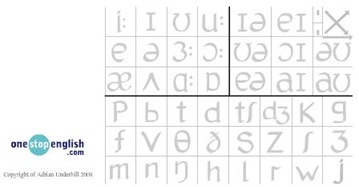
Interactive Phonemic ChartIt is often asked as to why there is no one-to-one correspondence between spelling and pronunciation in English i.e., why don’t we pronounce the English words exactly according to their spellings?  For example, if C-U-T is cut_devnagari B-U-T is but_devnagari then why pronounce P-U-T as put_devnagari? To understand this, we must first understand that in some languages in the world (as in Hindi or most Indian languages), one letter of alphabet stands for one sound in speech. Such languages are called  ‘phonetic’ languages.  English is not a ‘phonetic’ language. It means that in English one letter of the alphabet does not necessarily stand for one sound in speech. Every language has a particular number of sounds in it. The English language has 44 sounds. Among them, 20 are vowel sounds and 24 are consonant sounds. But the letters of the alphabet in English are only 26. Obviously, they cannot represent these 44 sounds. That is why, in English, we don’t pronounce English words exactly as per their spellings.

The next question then is- ‘how to represent the sounds in languages like English in written form (for dictionaries and linguistic documentation etc.)?’ The letters of the alphabet are lesser than the number of sounds. So they are unable to represent these sounds. What do we do then? To solve this problem, the linguists came up with a solution-a new script (or a new set of symbols) called the International Phonetic Alphabet (IPA) symbols. This script is language neutral. We can represent sounds in any language in this script. There are some languages in the world which are only spoken and never written. So they simply have no script at all. Many of these languages are on the verge of extinction. In order to preserve them, it was (and it still is) necessary to have a script that will be able to represent their sounds. The IPA symbols solved this problem. Now, have look at the adjacent chart with letters that look strange. Some of them seem to be like the letters of the English alphabet. This is a chart representing the 44 sounds of English language in IPA symbols. Please note that there are many IPA symbols but this chart consists of only those symbols that represent the sounds in English.

This is an interactive chart. Click on the picture of the chart to open it in a new browser window and then you can listen to the pronunciation of each sound followed by the pronunciation of an example word for  that sound. Must have either Adobe  Flash Player or the Shockwave plug-in installed on your computer for this interactive chart to work properly. If you don’t have them, you can download them by clicking their respective links below.
get_adobe_flash_player get_adobe_shockwave_player

I am grateful to www.onestopenglish.com (from where I have taken this chart) and Adrian Underhill (who owns the copyright for this chart) for providing this wonderful learning resource. Have fun !

Subverting the Paradigm…The Power of an Individual…

Ever wondered how individuals grow to greatness? Becoming great is never easy…turning hostile situations upside down takes some guts…but yes… if you believe you can do it, you certainly can do it. The first resource that I am uploading for my students (and for whosoever in interested in aspiring to soar high) is a YouTube video. Just watch it and you’ll feel like being on top of the world ! This is how you prove the world wrong…this is how you achieve things and this is how you Take Flight! Liked the song in the background?  It is Ameno by Era and it’s based on imaginary language similar to Latin. Click here for the lyric and click here to listen to the complete song. Do tell me how you liked the video and keep watching this space…there is much more in the pipeline.

Welcome to my blog !

mail

Hello World ! Welcome to my blog! I was thinking since long about setting up a blog or something on the Internet as a platform for me to express my feelings, thoughts and opinions, and also (primarily) to serve as a place where my students and colleagues can interact with me. I intend to make my blog a repository of resources in the areas (like Higher Education, English Language Education, Linguistics, English Literature Teaching and Cultural Studies)with which I am primarily concerned as a teacher and a learner. My students can find here freely downloadable course material like notes, links to other resources related to their subject, tips for study and self-improvement etc. Both my students and colleagues can find rich multimedia resources (which include audio and video lectures and articles and presentations of eminent teachers/scholars/trainers/academicians explaining important topics of  English Language, Literature, Linguistics, Cultural issues and Higher Education in general.) This blog is also a place where I’ll be discussing books- the ones which I have recently read, those that are my favourites books, new arrivals, or any other book(s) that I feel worth recommending to others.

All the visitors (particularly my students) are welcome to post their comments,criticize,appreciate, ask questions or suggest changes and improvements to this blog. It is high time I stop now and go to bed (coz its almost two in the morning and I have to wake up early tomorrow for the first lecture of the morning). Goodbye for now, thanks a lot for visiting and yes… keep watching this space for, it may take some time, but there’s a lot to come !