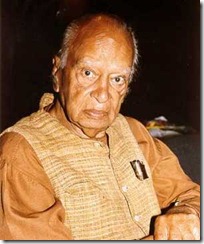
 Just a day before the television channels announced the demise of Dr. Mulk Raj Anand, I was talking to a friend of mine about how the literary world should celebrate when he turns hundred next year and the wish in question was the publication of his complete works or at least a unified edition of his complete non fiction by some institution like Sahitya Academy. The conversation was occasioned as my eyes fell on Dr. Anand’s book- Aesop’s Fables (his rendering of the Aesopian fables in English) and having not known about the book till then, I was amazed at the breadth of his intellect and the wide range of subjects he wrote on.
“…what is a writer if he is not the fiery voice of the people?”- Mulk Raj Anand once said and to nobody else is this comment more perfectly applicable than to himself. All along his long and illustrious career spanning more than seven decades, he was a fiery voice of the poor, the deprived, the downtrodden and the underdogs, recording their pains with extreme sensitivity and championing their cause with force.
Born on December 12, 1905 in Peshawar, the son of a coppersmith and head clerk in the Dogra regiment of the British Army, Mulk Raj Anand took his honours in philosophy from Punjab University, pursued further research in the same discipline at Cambridge and the University of London, and obtained PhD in 1929. The 1930s and 40s were the years of great tumult and turbulence in India and the rest of the world and as a man of action, having almost a Byronic temper, Anand could not keep himself aloof from what was happening around him. He travelled across Europe, spoke and wrote against Fascism, volunteered in the Spanish Civil War against Franco’s forces, and while he did all this, he also studied art under Anand Coomaraswamy and contributed to T. S. Eliot’s Criterion. But he was really propelled to serious writing, when the suicide of his aunt (who had been excommunicated simply because she shared her meal with a Muslim) stirred him bringing before him the ugly face of India. This inspired Untouchable. He prepared the first draft of The Untouchable in1932 while he was living at the Sabarmati Ashram with Gandhiji. But the novel was published much later in 1935 after being rejected by as many as nineteen British publishers. 1935 also saw the publication of R. K. Narayan’s Swami and Friends and in1938 came Raja Rao’s Kanthapura and thus was laid the foundation of the great Indo-Anglican novel by the great trio which was to produce many more gems.
Today, when many Indian and South Asian English writers are making their mark on the literary world, getting renowned publishers and high royalties for their novels, can we forget Mulk Raj Anand whose Untouchable was rejected by nineteen publishers and R. K. Narayan, who was thinking of drowning the manuscript of Swami and Friends?
Meanwhile, Anand’s stormy life entered into a phase of tranquillity when he settled down in Mumbai in 1946 and founded the art magazine Marg. After Untouchable, came Coolie, Two Leaves and a Bud, The Village and Across The Blackwaters- all of which won popular applause as well as critical acclamation.
As his fiction unlocks his heart, his non-fiction reveals his sharp and profound intellect and his commanding insight into the world of fine arts and culture. He was a multifaceted genius who could write on almost anything under the sun. The subjects of his non-fiction are wide ranging. From Aesopian fables to eroticism and from Gandhi to modern art, he wrote on almost everything that may please a man of letters.
Decorations inevitably came and came in scores. In 1962, he was appointed as Tagore Professor of Art and Literature at his alma mater, the Punjab University. This was followed by invitations from many other institutions of renown. Morning Face, the first part of his seven part autobiography, won him the Sahitya Academy award. He was also decorated with Padma Bhushan for his outstanding contribution to literature and arts. Many national and international professorships and fellowships were conferred but the Mulk Raj Anand, the man always rose above decorations. It was not just his literary genius, but his great humanism that made him great. It was this humanism, this tendency to be always there in the heat of the battle that gave power and vitality and force to whatever he wrote and spoke. Right till his last days he continued to work incessantly to make the world around him, a better place. He founded the Sarvodaya Trust and patronized many a charitable cause- especially for the poor Katori aboriginals who live in the vicinity of his Khandala retreat.in
A novelist, poet, painter, and critic, Anand was a man of many hues who laboured hard all along his life to enrich art, culture and secularism in India. Even in the last article that he wrote (‘Art and Essence’, published posthumously by The Times of India, September 29, 2004), he mourned that life, “has lost its richness under the utilitarian microscope” , probably because whatever he held dear, he saw it crumbling everywhere.
He was fortunate to have the blessing of a long life- a blessing that has often been a rarity for the literary greats. He was not in the limelight since quite sometime, but all those who admired him, were attached to him and had almost become ‘used’ to him; so much so that they almost forgot that he was a mortal. Now, almost after two years after his demise, as we contemplate over the richness of the legacy that he has left behind for posterity, there is not one soul that is not amazed. To enrich this legacy, will be the most befitting tribute to him.
 Nataly Kelly, Jost Zetzsche

 Prithvirajsingh Thakur