My Fair Lady – The rain in Spain stays mainly in the plain


Funny scenes from the Hollywood classic My Fair Lady (1964) (based on a musical adaptation of George Bernard Shaw’s play Pygmalion). Henry Higgins (Rex Harrison) is an eccentric professor of Phonetics who is always keen on making people cultivate ‘proper’ pronunciations, accent and tone. According to him it is the accent and tone of a person that decide his/her place and prospects in the society.  He claims to have a discerning knowledge of Phonetics. He once comes across a girl –Eliza Doolittle (Audrey Hepburn) who sells flowers on London streets. She is a rustic woman who speaks ‘cockney’ English (an ‘impure’ English spoken in East London). Higgins claims that with his excellent skills as a phonetician, he can make this girl speak English like a princess. He is challenged by his friend Colonel Pickering,(Wilfrid Hyde-White) a language enthusiast,  to pass her off as a princess. Higgins accepts this challenge and Eliza is persuaded on the pretext that if she learns to speak English the ‘proper’ way, she could get a job as a sales girl in London’s big flower shops. She agrees and then begins a tough but funny and interesting exercise of cultivating ‘correct’ pronunciations. In these scenes, Higgins asks Eliza to speak a tongue-twister ‘The rain in Spain stays mainly in the plain’ as a part of several pronunciation exercises that she has to do. Eliza falters a few times but makes it in the end and Higgins and Pickering are overjoyed because this is their first moment of success. At the end of the movie,Eliza successfully passes off as a princess at a party but after that she leaves Higgins because she is repelled by the rude behaviour of this eccentric professor who treats her like a machine. However, Higgins starts missing Eliza and soon discovers that he is actually in love with her. In the end, they unite and live happily ever after. In the original play, Shaw makes Eliza marry Freddy, a young man who loves her from the very beginning. This film was immensely popular and won 8 academy awards.

Where the Mind is Without Fear…

Where the mind is without fear and the head is held high
Where knowledge is free
Where the world has not been broken up into fragments
By narrow domestic walls
Where words come out from the depth of truth
Where tireless striving stretches its arms towards perfection
Where the clear stream of reason has not lost its way
Into the dreary desert sand of dead habit
Where the mind is led forward by thee
Into ever-widening thought and action
Into that heaven of freedom, my Father, let my country awake!

Happy Independence Day India ! Jai Hind !!Happy Independence Day India !

Here’s the man himself … The Good Old George Bernard Shaw

Dear students of First Year B.Com., we have recently finished reading ‘How I Became a Public Speaker’, a memoir by George Bernard Shaw, the great British/Irish playwright and thinker, narrating his ventures in the field of public speaking. We have already discussed some aspects of his life and personality at some length, but nothing can be better than to watch Shaw himself speaking. These are some of the videos of Shaw that I found on YouTube. Watch them and experience the razor-sharp tongue and even sharper wit (a typical Irish trait ) of this man who always took the world by storm with his unorthodox thoughts and of course, his fantastic literary and oratorical gifts.

This first video was filmed by Fox Movietone on 26th  August, 1928 when Shaw was on his first tour of America. He is just having a casual, plain hearty talk with the media-persons. He is surprised to see them and find himself in front of the camera all of a sudden. He’s just having fun, laughing at himself, making fun of the infamous Italian dictator Benitto Mussolini (who was then ruling Italy), having a go at the then prime minister of Britain, Lloyd-George- in other words, this is Shaw at his sarcastic best. Love him or hate him but you certainly can’t ignore him. I am giving below, a transcript of this video as uploaded on YouTube by the person who uploaded this video. Note that it contains some errors, but the major part of it is alright. For other videos, I couldn’t provide the transcript because I didn’t get them readymade and I had no time to create their transcripts because as Shaw says at the end of this video, “I’m afraid I’m always an extremely busy man – at least I pretend I am.” 🙂

Continue reading

Learn the English Sounds with Interactive Phonemic Chart

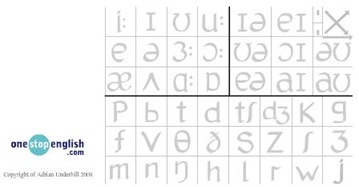
Interactive Phonemic ChartIt is often asked as to why there is no one-to-one correspondence between spelling and pronunciation in English i.e., why don’t we pronounce the English words exactly according to their spellings?  For example, if C-U-T is cut_devnagari B-U-T is but_devnagari then why pronounce P-U-T as put_devnagari? To understand this, we must first understand that in some languages in the world (as in Hindi or most Indian languages), one letter of alphabet stands for one sound in speech. Such languages are called  ‘phonetic’ languages.  English is not a ‘phonetic’ language. It means that in English one letter of the alphabet does not necessarily stand for one sound in speech. Every language has a particular number of sounds in it. The English language has 44 sounds. Among them, 20 are vowel sounds and 24 are consonant sounds. But the letters of the alphabet in English are only 26. Obviously, they cannot represent these 44 sounds. That is why, in English, we don’t pronounce English words exactly as per their spellings.

The next question then is- ‘how to represent the sounds in languages like English in written form (for dictionaries and linguistic documentation etc.)?’ The letters of the alphabet are lesser than the number of sounds. So they are unable to represent these sounds. What do we do then? To solve this problem, the linguists came up with a solution-a new script (or a new set of symbols) called the International Phonetic Alphabet (IPA) symbols. This script is language neutral. We can represent sounds in any language in this script. There are some languages in the world which are only spoken and never written. So they simply have no script at all. Many of these languages are on the verge of extinction. In order to preserve them, it was (and it still is) necessary to have a script that will be able to represent their sounds. The IPA symbols solved this problem. Now, have look at the adjacent chart with letters that look strange. Some of them seem to be like the letters of the English alphabet. This is a chart representing the 44 sounds of English language in IPA symbols. Please note that there are many IPA symbols but this chart consists of only those symbols that represent the sounds in English.

This is an interactive chart. Click on the picture of the chart to open it in a new browser window and then you can listen to the pronunciation of each sound followed by the pronunciation of an example word for  that sound. Must have either Adobe  Flash Player or the Shockwave plug-in installed on your computer for this interactive chart to work properly. If you don’t have them, you can download them by clicking their respective links below.
get_adobe_flash_player get_adobe_shockwave_player

I am grateful to www.onestopenglish.com (from where I have taken this chart) and Adrian Underhill (who owns the copyright for this chart) for providing this wonderful learning resource. Have fun !