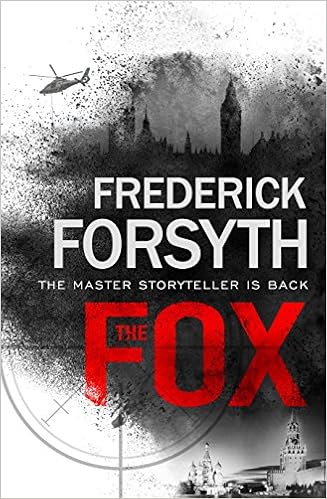
The Fox: A Thriller to Cherish…

Just finished reading Frederick Forsyth’s latest novel The Fox. This is the first Forsyth book that I have read. Had read quite a bit about Forsyth and his thrillers, but never really had the opportunity to read his novels. This time, the isolation after a Covid-19 infection gave me a chance to read as I please and I chose Forsyth’s The Fox.

The Fox is the latest (2018) novel of Frederick Forsyth and in line with his earlier thrillers, tells the story of checkmates in the game of espionage played on the stage of international politics. The novel begins with a raid of the British security forces on a house in Luton, England where a family of a suspected hacker who has managed to hack the supposedly impenetrable US military database at Fort Mede lives. The hacker eventually turns out to be a shy teenager called Luke Jennings having Asperger’s syndrome. He has unparalleled and incredible skills for hacking and it turns out that he has just casually hacked one of the most secure databases in the world. A British veteran spy spots the talent of the boy and manages to get him to work for the UK and USA saving him from a possible jail term in USA. The talent of the boy is leveraged to the use of the allied powers and he manages to hack robustly secure Russian, Iranian and North Korean security systems- thereby neutralizing potential threats to the West and the rest of the world from these ‘rouge’ states.

The novel has a thinly veiled story and most of the characters are from the real world. Only a select few have been not been mentioned by their names or imaginary names have been used for them, but most of the people and events are real and easily identifiable. The plot of the novel is very tightly and skillfully woven. There are no unnecessary details. However, the book is replete with lots of relevant details – historical, geopolitical and technological. What we enjoy in the novel is a series of moves and counter-moves in the field of espionage where there is always an urgency and eagerness to anticipate the move of the other side and score over it. Forsyth’s novels are stuffed with rich and very well researched details and this one is no exception. One is always amazed by the amount of research and detailing that goes into his novels.

The Fox is not just a piece of fiction. After reading it, one feels rich as one happens to know a lot of details about international politics, espionage, covert operations, intelligence agencies, modern warfare and weapons. The portraits of the key players on the stage of international politics are very vividly and accurately drawn.

What happens to the genius hacker and how the entire exercise ends, is something to be read and enjoyed. Forsyth’s first-hand knowledge of intelligence operations, his long stint as a journalist and his exceptional ability to weave a plot and tell the story make him the most popular storyteller of our times.
Few Haikus…

In December 2019, I attended a four-day workshop on Creative Writing led by Prof Alan Maley. We got to know a lot about creative writing and were made to do hands on exercises. We were asked to write Haikus- a Japanese genre of poems of three lines with 5 syllables each in the first and last line and 7 syllables in the middle line (5-7-5). The last line is usually striking and may contain some revelation. Selections from what we wrote during the workshop will appear in a book. Here are some of the Haikus that I wrote:
Haikus

  1. Cold and sleepless nights
    Long wait on deserted bed
    In painful fragrance

  2. On a dark evening
    Burning pyre of my teacher
    Enlightening all

  3. On a classroom wall
    A worm creeping up, falls down
    Tries again- succeeds

…and a Haibun

A Haibun:

Haibun, is also a Japanese literary genre in which a prose narrative is combined with Haikus. It is usually an account of a travel or some event. We were taken for a day expedition to Golkonda fort and then asked to write a Haibun about the trip. Here is that Haibun:

Haibun- Trip to Golkonda

It is 9:30. Almost all are here. We are waiting for some people. I am thinking of booking my return tickets. The very thought of climbing three-hundred steps of the Golkonda Fort makes me tired already. My inherent laziness makes me feel tired before I start. At the foot of the fort, we by ourselves hats to protect us from the unusually hot sun.

A poor young mother
Begging in vain for her child
Shaming affluence

Gate

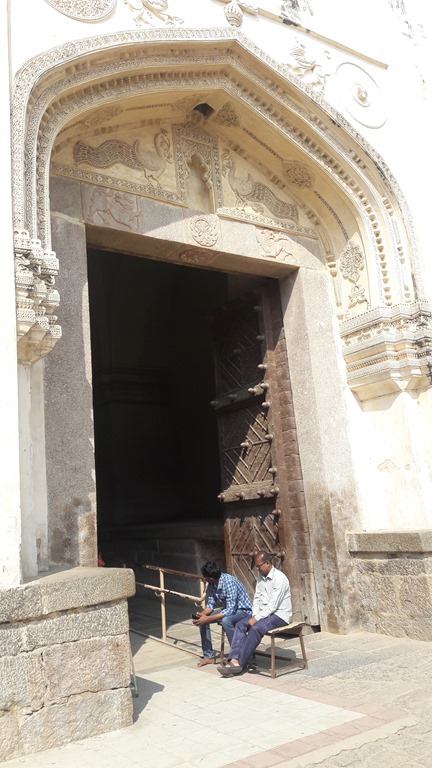
The entrance of the fort is very huge. It has a big gate where they check tickets. Carved at the top of the gate are the frescoes of a lion and lioness. But they look very similar to each other and it is not easy to differentiate between them. As we enter the fort, we see fortifications and elephantine rocks lost in unknown antiquity. The fort is well maintained and clean. There are mending works going on, but on an ancient structure, the modern mending work looks-
Continue reading

Paradise Forever Lost…

Lesser Breeds- a novel.  – Nayantara Sahgal
375 pp. Harper Collins. Rs. 395  ISBN:81-7223-444-9
——————————————————————
If, drunk with sight of power, we loose
Wild tongues that have not Thee in awe-
Such boastings as the Gentiles use,
Or lesser breeds without the Law-

These lines from Rudyard Kipling’s poem Recessional, printed on the first page of Mrs. Nayantara Sahgal’s latest novel- Lesser Breeds suddenly arrest our attention providing a hint of what lies ahead in the next three hundred and fifty odd pages.
The so called Lesser Breeds struggling against the self-decreed superior ones, is, what a considerable pat of human history has been and it is to this breed-mania that racism, imperialism and colonialism owe their parentage. Mrs. Sahgal’s novel is set in a period when these evils were rampant in the world and the struggle of the oppressed against the oppressors was the fiercest.
This struggle was on with all the might in the colonies in Asia and Africa but there was something different with it in India where the struggle was on with a weapon that the world had never seen or heard of before: the power of soul. This power soul was supposed to combat the power of bayonets, machineguns and bombs. This was the weapon of the ‘new creed’ which the world was watching evolve with awe; a creed which declared: “If blood must be shed in this battle, let I be your own”.
The world was watching with wide eyes, the prophetic Mahatma proclaiming this mantra to millions of India’s men and women. “If the enemy realized,” he was telling them, “you have not the remotest thought in your mind of raising your hand against him even for the sake of your life, he will lack the zest to kill you.” Gandhiji’s Great Experiment of Non-violence was definitely being watched by the world with awe, but did it work or was it just a lunatic’s fantasy or dreamy idealism? Does it have any significance for us today?

Mrs. Sahgal’s novel brilliantly discusses these still burning questions that history has put to us. The novel opens in early 1930s, one of the most turbulent epochs in Indian as well as world history. Nurullah, the protagonist, is a young man of twenty three who arrives at the historic city of Akbarabad to teach English literature to the ‘first years’ at the university. For nearly ten years since 1932, he lives with a non-violent family, actively involved in the freedom struggle in their once splendorous domed mansion which, after the family’s plunge into the quest for freedom, has now become a ‘national monument’. It is during his stay here, that Nurullah feels the heat of the freedom struggle and gets closely acquainted with the ebb and flow the movement through Bhai or Nikhil, the head of the family who himself is a freedom fighter and a firm believer in Non-violence. Continue reading