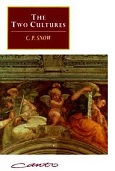
[This is an article on the book The Two Cultures by Sir C.P. Snow. This book is actually based on the Rede Lecture that C.P. Snow delivered in Cambridge in 1959. I’d written this article in 2010.]
 The year 2009 marked golden jubilee of one of the great intellectual debates in the contemporary intellectual history- a debate which is still alive and which still attracts the attention of even the most casual student of intellectual history- let alone academicians, scholars and public intellectuals- worldwide.
It was Sir C.P. Snow (later Lord Snow) who, on the afternoon of 7th May 1959 delivered a lecture in the University of Cambridge. The lecture was entitled “The Two Cultures and the Scientific Revolution”. Snow, eminent scientist, novelist, civil servant and an industry adviser was a well-known public intellectual in Britain. Himself a Cambridge educated scientist, Snow had long ago joined and later left the famous Cavendish laboratory of Cambridge. He was invited on 7th May 1959 to deliver the annual Rede Lecture in Cambridge which is still a significant event there.
Snow, in this lecture, for the first time, drew the attention of the world towards the yawning gap – the great divide between science and humanities and lamented the fact that while scientists are expected to be well read in the literary classics and well-acquainted with ‘high culture’, the humanities people never take the trouble of making themselves familiar with even the most basic knowledge of science. He took the humanities people to task for their snobbish attitude towards science and for their dismissal of scientific enterprise as materialistic pursuit.
Snow’s lecture sparked off a great controversy and invited passionate responses both for and against his thesis. This lecture was first published as a book entitled ‘The Two Cultures and the Scientific Revolution’ in 1959. The subsequent debate invited so passionate responses (particularly from the likes of F.R. Leavis and Lionel Trilling) that Snow had to answer the whole debate by publishing ‘The Two Cultures: A Second Look’ which was later included in the combined edition of the book published in 1963.
The book under review is the same combined edition published by Cambridge University Press with an introduction by Stefan Collini (Professor of English Literature and Intellectual History in Cambridge University). The book is worth reading as much for the sparkles of Snow’s ideas as for Professor Collini’s rich and comprehensive introduction which runs well past sixty pages and acquaints us with the whole history of this debate and its present and future.
Collini, in his introduction, tells us the history of the idea of the two cultures and also of the debate that followed Snow’s lecture. He gives us a brief biography of Snow and explains how the idea of the ‘two cultures’ had taken shape in Snow’s mind much earlier. After introducing Snow’s ideas at length, Collini gives us a detailed and comprehensive account of the great debate that followed the publication of Snow’s lecture- particularly, the controversy between Snow and F.R. Leavis. Next part of the book contains the actual Rede lecture by Snow.
Snow begins by alluding to his own previously published work on the subject and then goes on to elaborate his ideas. The lecture is divided into four small sections namely-
-
The Two Cultures, 2. Intellectuals as Natural Luddites, 3. The Scientific Revolution and 4.The Rich and the Poor.
Snow’s chief concern is the huge gap, the unfamiliarity and the hostility among the literary intellectuals and the scientists who represent ‘the traditional culture’ and ‘the scientific culture’ respectively. He calls the literary intellectuals as ‘natural Luddites’ (i.e. the people who are naturally averse to the scientific and technical progress and have little or no scientific knowledge). This separation, according to him, is mainly a result of the faulty British education system which introduces specialization too early. Snow’s advocacy for a better understanding among the two cultures was based on his concern that application of science is the only way of solving human problems. It is the only way of bridging the gap between the rich and the poor in the world and because most of the policy makers and administrators are trained in traditional culture, they remain ignorant, even insensitive, when it comes to the application of science for the removal human miseries. This need for a better understanding among the two cultures is needed the most in academies, because it is from there that the administrators, policy-makers, intellectuals and researchers come out.
The second section of this book contains ‘The Two Cultures: A Second Look’ which Snow wrote four years later in 1963 and answered the whole debate that followed his 1959 lecture.
Snow’s ideas may not seem as relevant today as they were in 1959 and it is difficult for anyone to be a Luddite in this age of information technology. We also hear much about interdisciplinary research these days. Probably, this term wasn’t even coined in Snow’s time. But one must not forget that the two cultures still exist today and the gap between them is still visible in many academic institutions and societies particularly in the Third World countries.
Snow himself does not consider his ideas original. They were, as he says, ‘floating in the air’. But it is to his credit that he gave voice to what has been justly regarded as one of the major intellectual concerns of our time. That Snow still remains readable and that his ideas are still being discussed in the form of books, articles and talks, is a testimony to the contemporary relevance of the whole issue of two cultures
 Prithvirajsingh Thakur