…and a Haibun

A Haibun:

Haibun, is also a Japanese literary genre in which a prose narrative is combined with Haikus. It is usually an account of a travel or some event. We were taken for a day expedition to Golkonda fort and then asked to write a Haibun about the trip. Here is that Haibun:

Haibun- Trip to Golkonda

It is 9:30. Almost all are here. We are waiting for some people. I am thinking of booking my return tickets. The very thought of climbing three-hundred steps of the Golkonda Fort makes me tired already. My inherent laziness makes me feel tired before I start. At the foot of the fort, we by ourselves hats to protect us from the unusually hot sun.

A poor young mother
Begging in vain for her child
Shaming affluence

Gate

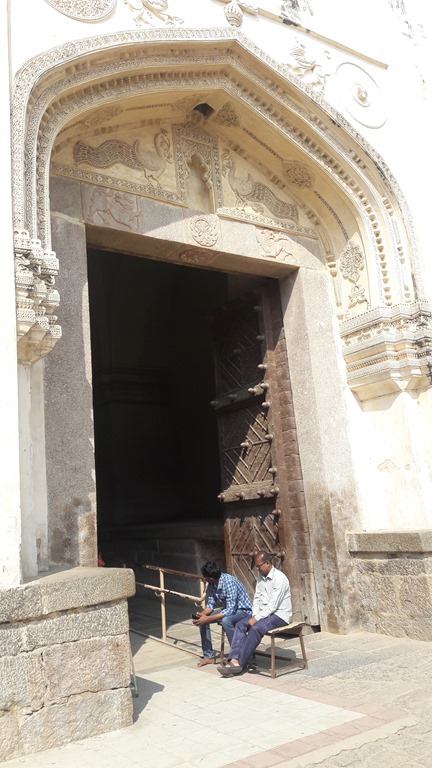
The entrance of the fort is very huge. It has a big gate where they check tickets. Carved at the top of the gate are the frescoes of a lion and lioness. But they look very similar to each other and it is not easy to differentiate between them. As we enter the fort, we see fortifications and elephantine rocks lost in unknown antiquity. The fort is well maintained and clean. There are mending works going on, but on an ancient structure, the modern mending work looks-
Continue reading

The Importance of Doing Nothing

imageIn the 19th century, Wordsworth, fed up with the frantic, feverish rush of the mundane pursuits of the contemporary society, complained in his own inimitable style that ‘the World is too much with us’.

We have no time- he said- to look at nature that is ours. We are wasting our powers only in earning money and spending it. He longed to get away from this mad rush. This was somewhere around early or mid-19th century in England. But the world has seen in an unprecedented change since then for the better and for the worse. Human life has gone on to become increasingly busy. The last decade of the 20th century in particular, brought with it, an unimagined and unforeseen upheaval in human life in the form of the great revolution in Information and Communication Technology. Continue reading

With a Few Regrets: The Story of K. Natwar Singh

OneLifeIsNot-Enough_thumb1
One Life is not Enough: An Autobiography
K. Natwar Singh. 464 pages. Rs. 500
Rupa Publications
978-81-291-3274-1


K. Natwar Singh is not a man you can ignore. You can love him, you can loathe him, but you certainly can’t ignore him. With an illustrious diplomatic career spanning three decades followed by twenty-five years in active politics, Natwar Singh has witnessed the history of modern India from close quarters. A self-proclaimed Nehruite, he has been an ardent supporter of the Nehru-Gandhi family, having worked with stalwarts like Jawaharlal Nehru, Indira Gandhi and Rajeev Gandhi. The autobiography of this octogenarian diplomat –turned –politician has created quite a stir and roused considerable interest with its startling revelations about Sonia Gandhi and her refusal to accept the prime minister’s post in 2004. However, the book cannot and should not be read only for these revelations and other spicy insider accounts that it contains. One cannot deny the fact that Natwar Singh, while telling his story, has also inevitably told the story of the making of modern India- particularly, its foreign policy. While doing so, he has given us interesting pen-portraits of the people who did it -the visionary and idealistic (but at times temperamental) Jawaharlal Nehru, the stern, majestic and capricious Indira Gandhi and the young dreamy romanticist- Rajeev Gandhi. We also have some delightful portraits of the world’s who’s who of past half-a-century.

Natwar Singh had a good fortune to work with all the top three Nehru-Gandhis- Jawaharlal, Indira and Rajeev.

Born to Govind Singh and Prayag Kaur, Natwar Singh’s childhood was spent in Bharatpur and Deeg. His father was a Diwan of the Bharatpur principality. Natwar was educated at Mayo College, Ajmer, Scindia School, Gwalior and St. Stephen’s College, New Delhi from where, he graduated in history with honours. Natwar Singh later went to Cambridge for further study and while at Cambridge, he entered into the Indian Foreign Service in 1953. After a long bachelorhood, he married Maharajkumari Heminder Kaur of Patiala in 1968. Continue reading

Paradise Forever Lost…

Lesser Breeds- a novel.  – Nayantara Sahgal
375 pp. Harper Collins. Rs. 395  ISBN:81-7223-444-9
——————————————————————
If, drunk with sight of power, we loose
Wild tongues that have not Thee in awe-
Such boastings as the Gentiles use,
Or lesser breeds without the Law-

These lines from Rudyard Kipling’s poem Recessional, printed on the first page of Mrs. Nayantara Sahgal’s latest novel- Lesser Breeds suddenly arrest our attention providing a hint of what lies ahead in the next three hundred and fifty odd pages.
The so called Lesser Breeds struggling against the self-decreed superior ones, is, what a considerable pat of human history has been and it is to this breed-mania that racism, imperialism and colonialism owe their parentage. Mrs. Sahgal’s novel is set in a period when these evils were rampant in the world and the struggle of the oppressed against the oppressors was the fiercest.
This struggle was on with all the might in the colonies in Asia and Africa but there was something different with it in India where the struggle was on with a weapon that the world had never seen or heard of before: the power of soul. This power soul was supposed to combat the power of bayonets, machineguns and bombs. This was the weapon of the ‘new creed’ which the world was watching evolve with awe; a creed which declared: “If blood must be shed in this battle, let I be your own”.
The world was watching with wide eyes, the prophetic Mahatma proclaiming this mantra to millions of India’s men and women. “If the enemy realized,” he was telling them, “you have not the remotest thought in your mind of raising your hand against him even for the sake of your life, he will lack the zest to kill you.” Gandhiji’s Great Experiment of Non-violence was definitely being watched by the world with awe, but did it work or was it just a lunatic’s fantasy or dreamy idealism? Does it have any significance for us today?

Mrs. Sahgal’s novel brilliantly discusses these still burning questions that history has put to us. The novel opens in early 1930s, one of the most turbulent epochs in Indian as well as world history. Nurullah, the protagonist, is a young man of twenty three who arrives at the historic city of Akbarabad to teach English literature to the ‘first years’ at the university. For nearly ten years since 1932, he lives with a non-violent family, actively involved in the freedom struggle in their once splendorous domed mansion which, after the family’s plunge into the quest for freedom, has now become a ‘national monument’. It is during his stay here, that Nurullah feels the heat of the freedom struggle and gets closely acquainted with the ebb and flow the movement through Bhai or Nikhil, the head of the family who himself is a freedom fighter and a firm believer in Non-violence. Continue reading